Tuesday, April 18, 2006

My Portfolio Analysis - as on 18th Apr 2006

Below is my portfolio analysis for stock investment. I have started investing in stocks since 1st october 2005. Most of the stocks I have invested in just recently. I shall be periodically updating this and posting it. Also I will start posting the reasoning behind picking these particular stocks.


Here is the list of companies I have invested in till date:

Mahindra and Mahindra - M & M
ICICI Bank
Yes Bank
Hindustan Construction Corporation - HCC
Larsen and Turbo - L&T
ITC
Royal Orchid
Aftek Infosys
Infosys
Paradyne Infotech
Satyam
Visesh Infotechnics
Wipro
Hindalco
Bartronics
Patel Engineering
Piramyd Retail
Rajesh Exports
Western Hatcheries - Venkys
Bharti Tele Ventures
Reliance Communication Ventures
Celebrity Fashions
Kewal Ketan Clothings
Provogue
ABG Shipyard

Friday, April 14, 2006

Investment and Finance - Introduction

Ok here is some information about my interest in the field of Investment and Fianance... In my future posts I'll be writing more about this. To start with here is some background...

Summary of basic knowledge in Investment and Finance field till date:

1. Interested in the working of Global economy
2. Investment – Stocks, Real Estate, Commodity
3. Enjoyed reading few books on Investment
a. Rich Dad Poor Dad
b. Warren Buffet Way
c. One up on Wall street – Peter Lynch
d. The Intelligent Investor – Benjamin Graham
e. Read a lot of articles on Investment on web (all articles on Investopedia, ICICI Direct, Economic Times, etc)
4. Very impressed by Buffet ideology of Value and Long Term Investing which in turn is based on Benjamin Grahams’
5. Understand basics of Oil Prices, Interest Rates, Inflation and the impact on global economy and markets
6. Interested in studying and exploring Indian market and companies
7. Regularly track Indian Stock Market, News on NDTV Profit, CNBC, Economic Times news paper, Investment magazines
8. Understand the functioning of business and the parameters involved like Revenues, Expenses, P&L, EBIDTA, Debt, Net Profits etc
9. Understand the factors affecting business like Demand / Supply, Competition, Value addition, Management principles, Mission and Values, Employee Satisfaction, Productivity, Economic conditions, GDP etc
10. Understand software industry and software products in depth
11. Overall interested in keeping track of world news and reading on various topics

Wednesday, April 12, 2006

The Second Law of Thermodynamics

The Second Law of Thermodynamics

“Nothing in life is certain except death, taxes, and the second law of thermodynamics.”


‘The Second Law of Thermodynamics’ also known as ‘Entropy’ or ‘Arrow of Time’ is perhaps the biggest, most powerful, most general idea in all of science. Why paper, trees, coal, gas and all things like them burn (and why people "should" spontaneously catch fire in air), why sand and dry ice even in pure oxygen can't ever burn, why the sun will eventually cool down, why iron rusts (but not why it rusts faster nearer the ocean), why there are hurricanes or any weather at all on earth, what makes things break, why houses get torn apart in tornadoes or explosions, and perhaps the most important thing for us - why everything living tends to die.

Who cares about the second law of thermodynamics?
Well, anyone who wonders how the material world, our world of energy and matter, works.

Look at the direction that energy flows in any happening or process or event. That is the first step to understanding what the second law of thermodynamics is and what it applies to. “Energy spontaneously tends to flow only from being concentrated in one place to becoming diffused or dispersed and spread out.”

The second law is a straightforward law of physics with the consequence that, in a closed system, you can't finish any real physical process with as much useful energy as you had to start with — some is always wasted. This means that a perpetual motion machine is impossible. The second law was formulated after nineteenth century engineers noticed that heat couldn’t pass from a colder body to a warmer body by itself.

The perfect illustration is: A hot frying pan cools down when it is taken off the kitchen stove. Its thermal energy ("heat") flows out to the cooler room air. The opposite never happens.
A glass falls down from the top of a table and breaks into pieces. The opposite never happens.
Air in a high-pressure tyre shoots out from even a small hole in its side to the lower pressure atmosphere. The opposite never happens.

The big deal is that all types of energy spread out like the energy in that hot pan does (unless somehow they're hindered from doing so) They don't tend to stay concentrated in a small space; they flow toward becoming dispersed if they can -- like electricity in a battery or a power line or lightning, wind from a high pressure weather system or air compressed in a tire, all heated objects, loud sounds, water or boulders that are high up on a mountain, your car's kinetic energy when you take your foot off the gas. All these different kinds of energy spread out if there's a way they can do.

Run that Titanic movie as the ship hits the iceberg. See those steel plates ripped open and the ship begin to sink. Realistic, right? Can you imagine a real happening in which the reverse occurs? A sinking ship whose steel side heals up as it comes up out of the water and floats? Ridiculous! Too stupid to think about. But why is it stupid? Because it is so improbable from our experience. Only a movie run backward would show that kind of unrealistic fantasy. The second law isn't some weird scientific idea. It fits with everything common happening that we know.

A swimmer doesn't come shooting up out of the water to the diving board, rocks in a valley don't suddenly roll up a mountain, outside air doesn't rush into a flat tire, batteries don't get charged by sitting around. Those events all would have energy spontaneously become more concentrated, the opposite of energy spreading out.

The second law points the direction of how we feel time goes.

Our psychological sense of time is based on the second law.
It summarizes what we have seen, what we have experienced, what we think will happen.


Hence, it’s also known as the Arrow of Time.



Entropy just measures the spontaneous dispersal of energy: how much energy is spread out in a process, or how widely spread out it becomes – as a function of temperature.
The second law always predicts increase in dispersed energy or entropy in the universe. We humans tend to think of concentrated energy as ‘order’ and dispersed energy as ‘disorder’. Inflated tyre – order, Punctured tyre – disorder; A glass sitting on top of table – order, broken glass on ground – disorder. Thus, we can state that there is always an tendency towards increase of disorder in the universe.

If I hold a small rock in my fingers so it is ready to fall, it has potential energy concentrated in it because it is up above the ground. If the second law is so great and powerful, why doesn't the energy that has been concentrated in the rock spread out? Obviously, it can't do that because my fingers are "bonding" to it, keeping it from falling. The second law isn't violated. That rock tends to fall and diffuse its energy to the air and to the ground as it hits -- and it will do so spontaneously by itself, without any help -- the second I open my fingers and "unbond" the rock.

Important: It is a tendency rather than a prediction of what will happen right away.

Energies can be blocked in systems over a time spanning from few microseconds to few hours to few years to millions of years or even more. However, the energies will spread out sometime or the later for sure.

Blockage of the second law is absolutely necessary for us to be alive and happy. Not one of the complex chemical substances in our body and few in the things we enjoy would exist for a microsecond if the second law wasn't obstructed. Its tendency is never eliminated but fortunately for us, there are a huge number of compounds in which it is blocked for our lifetimes and even far longer.

The second law is the Greatest Good and the Biggest Bad to us:

The GOOD: Because of the second law -- the direction of energy flow -- life is possible.

We can take in concentrated energy in the form of oxygen plus food and use some of that energy unconsciously to synthesize "uphill" complex biochemicals and to run our bodies, consciously for mental and physical labor, excreting diffused energy as body heat and less concentrated energy substances.
We can use concentrated energy fuels (e.g., gasoline/coal, plus oxygen) to gather all kinds of materials from all parts of the world and, regardless of how much energy it takes, arrange them in ways that please us. Similarly, we can effect millions of non-spontaneous reactions -- getting pure metals from ores, synthesizing curative drugs from simple compounds, altering DNA.
We can make machines that make other machines, machines that mow lawns, move mountains, and go to the moon. We can make the most complex and intricate and beautiful objects imaginable to help or delight or entertain us.
The BAD: Because of the second law -- the direction of energy flow -- life is always threatened.

Every organic chemical of the 30,000 or more different kinds in our bodies that are synthesized by nonspontaneous reactions within us is metastable. All are only kept from instant oxidation in air by activation energies. (The loss or even the radical decrease of just a few essential chemicals could mean death for us.)
Living creatures are essentially energy processing systems that cannot function unless a multitude of "molecular machines", biochemical cycles, operate synchronically in using energy to oppose second law predictions. All of the thousands of biochemical systems that run our bodies are maintained and regulated by feedback subsystems, many composed of complex substances. Most of the compounds in the feedback systems are also synthesized internally by thermodynamically nonspontaneous reactions, effected by utilizing energy ultimately transferred from the metabolism (slow oxidation) of food. When these feedback subsystems fail -- due to inadequate energy inflow, malfunction from critical errors in synthesis, the presence of toxins or competing agents such as bacteria or viruses -- dysfunction, illness, or death results: energy can no longer be processed to carry out the many reactions we need for life that are contrary to the direction predicted by the second law.
You can't get any better for good -- that living is possible due to the second law. And you can't get much worse for bad -- that death is always possible too, due to the second law.

It is really the mother of all serious Murphy's Laws that apply to things.

Still more important to one's philosophy about life, these chemical ideas can startle us into seeing how fortunate we all are: that things don't go wrong more often!

Shouldn't "Why me?" be our near-constant question of wonder and delight at being alive and being able to move and think and create -- in a second-law world that favors dispersed energy and inert sand? Knowledge of the second law makes unrealistic the human cry of "Why me?" that is so frequent at times of tragedy.

At such times, the only rational response is "Why not me?” even though then it is emotionally quite unacceptable.

Life is hard. But it's harder if you don't know how the material world works!


Quotes including the second law

"If someone points out to you that your pet theory of the universe is in disagreement with Maxwell's equations, then so much the worse for Maxwell's equations. And if your theory contradicts the facts, well, sometimes these experimentalists make mistakes. But if your theory is found to be against the Second Law of Thermodynamics, I can give you no hope; there is nothing for it but to collapse in deepest humiliation"--- Sir Arthur Eddington

"Nothing in life is certain except death, taxes and the second law of thermodynamics. All three are processes in which useful or accessible forms of some quantity, such as energy or money, are transformed into useless, inaccessible forms of the same quantity. That is not to say that these three processes don't have fringe benefits: taxes pay for roads and schools; the second law of thermodynamics drives cars, computers and metabolism; and death, at the very least, opens up tenured faculty positions"---Seth Lloyd, writing in Nature 430, 971 (26 August 2004); doi: 10.1038/430971a

"A good many times I have been present at gatherings of people who, by the standards of the traditional culture, are thought highly educated and who have with considerable gusto been expressing their incredulity at the illiteracy of scientists. Once or twice I have been provoked and have asked the company how many of them could describe the Second Law of Thermodynamics. The response was cold: it was also negative."---C.P. Snow Rede Lecture in 1959 entitled "The Two Cultures and the Scientific Revolution".

Reference Links and Credentials:

Second Law
entropysimple
shakespeare2ndlaw
entropysite

Frank L. Lambert, Ph. D.
Professor Emeritus (Chemistry)
Occidental College
Los Angeles, CA 90041

Six degrees of separation

Six degrees of separation:


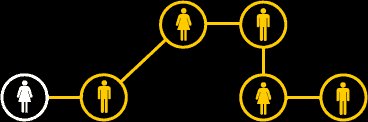
Ok. So you have a crush on Tom Cruise or Penelope Cruz but feel sad that they are inaccessible. Well, think again, the good news is you are only at the most six handshakes away from them. Don’t believe! Read on.

You may have heard that everyone on Earth is separated from anyone else by no more than six degrees of separation, or six friends of friends of friends.

Six degrees of separation is the theory that anyone on the planet can be connected to any other person on the planet through a chain of acquaintances that has no more than five intermediaries. The theory was first proposed in 1929 by the Hungarian writer Frigyes Karinthy in a short story called "Chains."


In the 1950's, Ithiel de Sola Pool (MIT) and Manfred Kochen (IBM) set out to prove the theory mathematically. Although they were able to phrase the question (given a set N of people, what is the probability that each member of N is connected to another member via k_1, k_2, k_3...k_n links?), after twenty years they were still unable to solve the problem to their own satisfaction.

In 1967, American sociologist Stanley Milgram devised a new way to test the theory, which he called "the small-world problem." He randomly selected people in the mid-West to send packages to a stranger located in Massachusetts. The senders knew the recipient's name, occupation, and general location. They were instructed to send the package to a person they knew on a first-name basis who they thought was most likely, out of all their friends, to know the target personally. That person would do the same, and so on, until the package was personally delivered to its target recipient.

Although the participants expected the chain to include at least a hundred intermediaries, it only took (on average) between five and seven intermediaries to get each package delivered. Milgram's findings were published in Psychology Today and inspired the phrase "six degrees of separation." Playwright John Guare popularized the phrase when he chose it as the title for his 1990 play of the same name.

Although Milgram's findings were discounted after it was discovered that he based his conclusion on a very small number of packages, six degrees of separation became an accepted notion in pop culture after Brett C. Tjaden published a computer game on the University of Virginia's Web site based on the small-world problem. Tjaden used the Internet Movie Database (IMDB) to document connections between different actors. Time Magazine called his site, The Oracle of Bacon at Virginia, one of the "Ten Best Web Sites of 1996."

In 2001, Duncan Watts, a professor at Columbia University, continued his own earlier research into the phenomenon and recreated Milgram's experiment on the Internet. Watts used an e-mail message as the "package" that needed to be delivered, and surprisingly, after reviewing the data collected by 48,000 senders and 19 targets (in 157 countries), Watts found that the average number of intermediaries was indeed, six. Watts says this shows that email has not fundamentally changed the way social ties are created.

"Why is the small-world phenomenon surprising?” "Why shouldn't it be obvious that we're only 6 degrees of separation apart, or some other small number?" Mathematically minded people, often approach the question with a simple calculation: suppose I have 100 friends, each of whom also has 100 friends. A hundred times 100 makes 10,000 friends of my friends. If each of those 10,000 people has 100 friends, there will be 1 million people 3 degrees away from me. Five steps away, there are 10 billion. So a lot of people would say it's not surprising that the degree of separation is small, because within 5 steps you've done the whole planet.

But there's a big assumption in that calculation. It presumes that each 100 friends are 100 new people. If everyone chose their friends at random from the entire world, the assumption would be valid, but we clearly don't. "The world that we live in is not at all random," as Watts points out. "We are very much constrained by our socioeconomic status, our geographical location, our background, our education and our profession, our interests and hobbies. All these things make our circle of acquaintances highly nonrandom."

To understand then how this works exactly we have to know how hybrid networks function. This is explained in a nice and detailed article at this link.

Watts' research, and the advent of the computer age, has opened up new areas of inquiry related to six degrees of separation in diverse areas of network theory such as power grid analysis, disease transmission, graph theory, corporate communication, and computer circuitry.

The Broken Window Theory

An Epidemic Theory of Crime -
The Broken Window Theory:


The epidemic theory of crime says that crime is contagious – just as fashion trend is contagious – that it can start with a broken window and spread to an entire community.
The ‘Broken Window’ theory tries to explain why certain areas / cities / places have a higher crime rate than others.

Broken widows was a brainchild of criminologists James Q. Wilson and George Kelling. Wilson and Kelling argued that crime is the inevitable result of disorder. If a window is broken and left unrepaired, people walking by will conclude that no one cares and no one is in charge. Soon, more windows will be broken, and the sense of anarchy will spread from the building to the street on which it faces, sending a signal that anything goes. In a city, relatively minor problems like graffiti, public disorder, and aggressive panhandling, they write are all equivalent of broken windows, invitation to more serious crimes.

This thesis suggests that the following sequence of events can be expected in deteriorating neighborhoods. Evidence of decay (accumulated trash, broken windows, deteriorated building exteriors) remains in the neighborhood for a reasonably long period of time. People who live and work in the area feel more vulnerable and begin to withdraw. They become less willing to intervene to maintain public order (for example, to attempt to break up groups of rowdy teens loitering on street corners) or to address physical signs of deterioration.

Sensing this, teens and other possible offenders become bolder and intensify their harassment and vandalism. Residents become yet more fearful and withdraw further from community involvement and upkeep. This atmosphere then attracts offenders from outside the area, who sense that it has become a vulnerable and less risky site for crime.


The "broken window" theory suggests that neighborhood order strategies such as those listed below, help to deter and reduce crime.

• Quick replacement of broken windows
• Prompt removal of abandoned vehicles
• Fast clean up of illegally dumped items, litter and spilled garbage
• Quick paint out of graffiti
• Finding (or building) better places for teens to gather than street corners
• Fresh paint on buildings
• Clean sidewalks and street gutters

As mayor of New York, Rudy Giuliani put the theory to work by strictly enforcing laws against small crimes - subway fare evasion, for example. As a result the crime rate (including serious crimes) in New York reduced by a considerable amount in past decade.

This theory has been widely put into practice by Police Departments through out the world. The ‘Broken Window Theory’ has inspired police departments in New York and other major cities to crack down on the small stuff in order to keep out the big stuff. It works: keeping on top of broken windows, graffiti, and other small infractions has reduced the serious crime level.

Does this theory apply to scenarios outside crime? Sure, it does. For example, building software projects...

Don't leave ‘broken windows’ (bad designs, wrong decisions, or poor code) unrepaired. Fix each one as soon as it is discovered. If there is insufficient time to fix it properly, then board it up. Perhaps you can comment out the offending code, or display a "Not Implemented" message, or substitute dummy data instead. Take some action to prevent further damage and to show that you're on top of the situation.

Functional systems deteriorate pretty quickly once windows start breaking. There are other factors that can contribute to software rot, but neglect accelerates the rot faster than any other factor.